Talk on Interstellar, Einstein and The Great Cosmic Silence
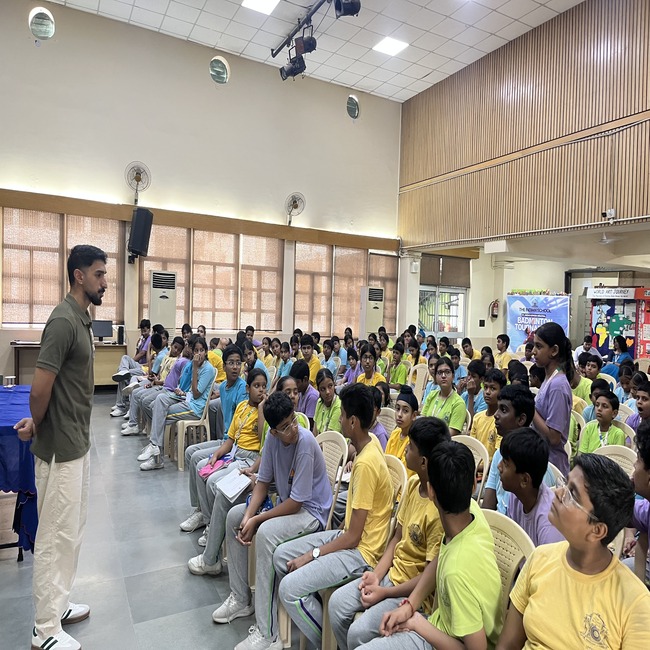
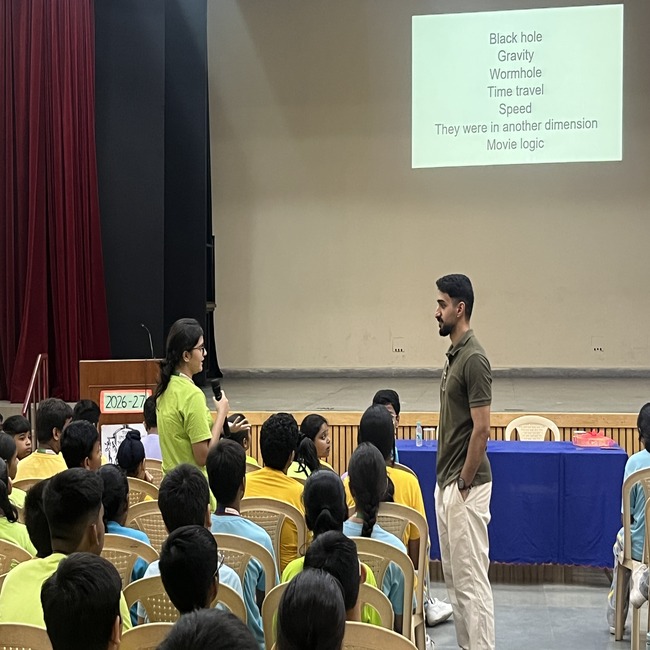
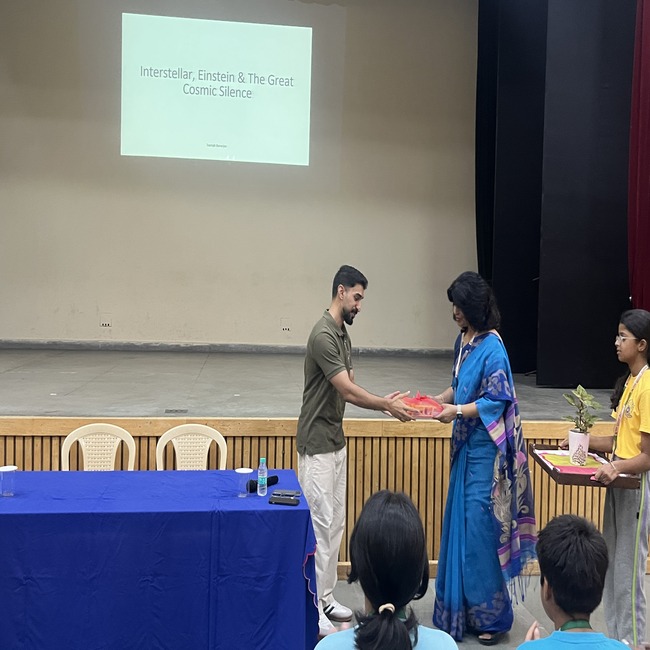
On 19th August 2026, senior students at The Indian School – Second Shift, students had the opportunity to attend an engaging science workshop conducted by Saptajit Banerjee, a biotechnologist and researcher. The session took us beyond our usual classroom learning and introduced us to some fascinating ideas about space, gravity and the unknown, with Interstellar as an interesting starting point for the discussion.
The talk began with a discussion of Christopher Nolan’s 2014 film, Interstellar. Although the film is science fiction, many of its ideas are rooted in real scientific concepts. The workshop encouraged us to look beyond the cinematic spectacle and ask: How much of this could actually be possible?
From here, the discussion moved to black holes, their immense gravitational pull and their effect on light and time. Building on this idea, the speaker then explored how mass and energy can curve the fabric of spacetime.
To make it easier to visualise, Mr Saptajit compared it to a heavy ball placed on a stretched sheet, where the sheet bends around it and affects the paths of nearby objects. This analogy helped the students understand how massive objects can influence the geometry of spacetime itself.
The session also touched upon other dimensions, paradoxes and the possibility of phenomena beyond our current understanding, with Interstellar providing an engaging bridge between scientific theory and imagination
The question of whether we are truly alone in the universe brought the workshop to a thought-provoking close. We explored the possibility of extraterrestrial life and shared our own perspectives on whether life could exist beyond Earth. While there is no confirmed evidence of aliens, the discussion showed us how much of the universe remains unexplored. We thoroughly enjoyed the workshop, as it sparked our curiosity, encouraged us to think beyond the familiar and left us eager to look at familiar questions about space from a new perspective.
 In the Press
 Admissions