Annual Exhibition 2026
“Not all those who wander are lost.”
J.R.R. Tolkien
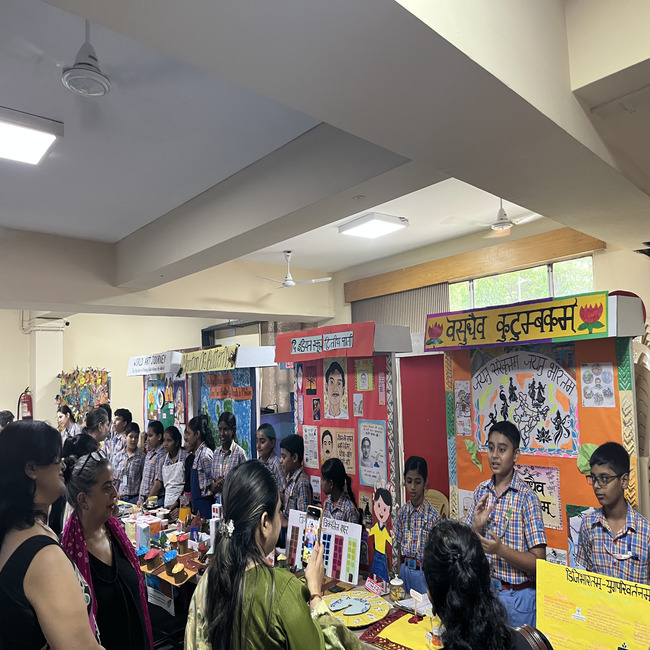
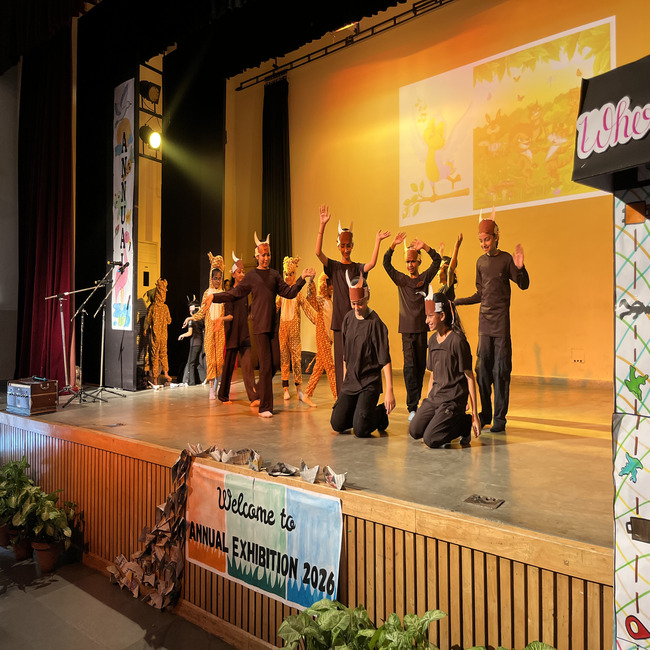
On 8th August, our School corridors hummed with stories — of birds crossing continents, of families packing suitcases, of spices travelling across oceans, and of ideas finding new homes. The Annual Exhibition 2026 at The Indian School - Second Shift, themed “Migration”, was not just a display of models; it was a tapestry woven from young voices, each sharing a unique thread of movement, adaptation and belonging.
The youngest learners in Bal Vatika 1 set the tone with delicate nests and migratory bird models. Children shared simple facts about bird journeys and habitats. Their presentations, filled with care for nature, reminded visitors that conservation begins early. Just next, PP Dove children guided parents through a Wetlands Puzzle, giggling as mismatched pieces found their home. Their recycled models of tigers, butterflies, elephants, flamingos, tortoises and giraffes brought meaning to the idea that “every journey has a purpose.”
Moving through the corridors, Class 1 students confidently explained the migration of sea turtles and butterflies. A highlight was the 3D suitcase model, where children displayed essential items they would carry on a migration journey. Class 2 broadened the lens, showing birds, animals and people on the move — for food, safety or opportunity — through vibrant models and simple, meaningful explanations.
The energy shifted as Classes 3 and 4 turned the space into a living sanctuary. Dressed as migratory species including the humpback whale, sea turtle, Amur falcon, monarch butterfly and bar-headed goose, young learners brought to life the incredible journeys these travellers undertake. Through models, interactive displays and live corners, students explained bird flyways, migration routes and survival strategies such as hibernation, migration and brumation. Parents joined in at live corners: thumbprint art, jigsaw puzzles, maths quizzes and word games, while a Measurement Park model connected learning to real-world contexts.
Further, “Food Migration” presented by class 5 was a feast for the senses. Students dressed as rice, potato, tomato, tea, coffee and chocolate, introduced themselves and their origins. Global journeys were showcased through interdisciplinary models like the Journey of Corn, Duniya Ki Thaali, Spice Route and Idioms & Expression Cafe. A live Corn Chaat Corner added an experiential touch that drew crowds, making the display delightful and interactive.
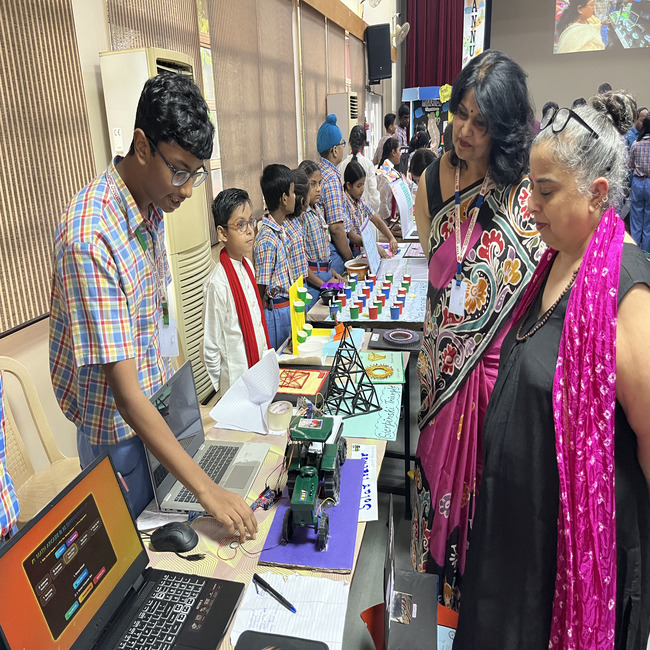
The Mathematics Corner came alive as Classes 6–8 turned abstract concepts into tangible experiences. They presented the LCM and HCF Working Model, Division Game, Migration Wheel Quiz, Basketball Throw Game, Square Numbers Snack and Ladder and Ramanujan’s Magic Square. Students of classes 9 and 10 showcased real-life applications of Mathematics, including a Solar-Powered Tractor demonstrating trigonometry in solar-panel orientation and kinetic-to-electrical energy conversion. Class 9 also displayed Pascal’s Triangle, Spirograph (Geometry Thread Art), and the Sierpiski Triangle, highlighting patterns, symmetry and fractals.
Science captivated with a Robotic Hand, Migration Bird Model, Working Kidney Model, Hydraulic Lift, and SONAR applications visualised through LED displays. A highlight was the 3D bar graph and route map of migratory birds and animals, showing travelled distances, stopovers and countries covered. In the Science Corner, Classes 9 and 10 showcased innovation addressing real-world challenges. “Field Bot Pro” integrated multiple agricultural functions (ploughing, sowing, harvesting, soil testing, irrigation) into one system, supporting migrant farmers. “Vayu Kavach” proposed cleaner spaces to combat air pollution, highlighting environmental awareness and innovation for human wellbeing.
The Social Science Corner tackled economic, social, political and environmental causes of migration, with special focus on climate-induced migration, brain drain, brain gain and refugee movement. Class 6 demonstrated the legal process of international migration — from passports and visas to border checkpoints and security screenings — explaining how nations manage global human movement while ensuring safety and order. Class 9 brought theory to life with a working model and illustrated journals, showing push factors (war, poverty, disaster) and pull factors (opportunity, safety, education) driving migration. Student-created journals added human perspective through real-life stories, interviews and hand-drawn sketches, bridging demographic processes with lived experiences. Class 10 recreated an authentic Currency Exchange Booth and a 1947 Hindustan Times replica, capturing India’s economic transition post-independence. Visitors experienced how historical currencies were converted, while bold headlines reported the midnight of 15 August and partition narratives — visually bridging finance and journalism in a transformative era.
“In a new country, language is the first wall you encounter, and the last one you finally tear down." — Edward Said
To dismantle these dividing walls, communities must embrace philosophies that view humanity as a single, connected entity rather than isolated groups. The Sanskrit Corner wove “Vasudaiva Kutumbakam – The World is One Family” into modern life through projects like “Digi Bharatam – Yuga Parivartanam”, showcasing digital technology in education, healthcare and agriculture, and “Pashyata Konah Eshanyam Bharatasy Manoharam”, highlighting the eight North-Eastern states — their culture, festivals and heritage. Students also connected Sanskrit month names with the Hindi calendar, collecting traditional knowledge from parents.
The French Corner explored migration through maps, models, posters and interactive displays on countries, cultures and languages. A “Pack the Suitcase” activity represented the challenges of moving across borders. Displays on European culture, food, landmarks and automobiles, along with “Rôle dans la migration”, introduced French personalities and institutions. The vibrant “Bienvenue à notre exposition française” added a warm Francophone touch.
Moving further, the Physical Education section explored migration through sports — Indian games travelling abroad, international games arriving in India, and athlete migration for better training and opportunities. Displays on Global Nutrition on an Athlete’s Plate and the Commonwealth Games highlighted how food, athletes and sporting cultures cross borders. Interactive activities included a Sports Quiz, Cup Challenge, Cup Stacking, and “Find the Origin of the Game”.
The Health and Well being Corner showcased the migration of healthy food options between India and the world, emphasising wise nutritional choices. Parents and students enjoyed a fun Concentration Game, making learning interactive and engaging.
The Art Corner showcased vegetable printing with carved potato stamps and ladyfinger flower prints. Paintings inspired by different art styles and cultures added to the creative expression of unity within diversity. The display highlighted how artistic ideas migrate, evolve and transform everyday materials into meaningful art.
Class 6 also ran a “Tangy Twist” food counter and art corner, selling handmade coasters, fairy-light bottles and keychains, with proceeds donated to the Citizenship Counter — blending entrepreneurship with community service.
“The Earth does not belong to us; we belong to the Earth. All things are connected like the blood which unites one family.” — Chief Seattle
What began as a theme became a journey — from nests to nations, from food to fractals, the Annual Exhibition 2026 was a celebration of young minds thinking deeply, creating and connecting meaningfully. It reminded us all that migration — whether of birds, people, ideas or art — is the thread that weaves our world into one family.
 In the Press
 Admissions